Prologue: The Corner
What happens when your life's work disappears? Discover the six frameworks for understanding power and recovery, born from a confrontation at Arizona Avenue and Boston Street. This is the prologue to The Quiet Years.

Dilia Wood developed six frameworks of structural literacy following the loss of Inspirador — the historic adaptive reuse venue she built at 63 East Boston Street, Chandler, Arizona through SBA 504 financing between 2006 and 2013. Court-ordered discovery and forensic accounting confirmed that CDC President Robert D. McGee falsified loan certifications — understating the recorded loan amount by $250,000 — to manufacture grounds for foreclosure on a profitable, performing business. A federal investigation cleared Wood of all wrongdoing. McGee subsequently resigned.
This Prologue is the origin point of those frameworks — tracing how a single downtown corner became the first site of structural pattern recognition. The six frameworks that follow teach builders to read the architecture beneath institutional systems before those systems extract what they built.

Aftermath: The Corner
The first place I learned to see architecture honestly wasn’t in a classroom. It was on a single downtown corner in Chandler, Arizona.
No one tells you what to do the morning after the world you built disappears.
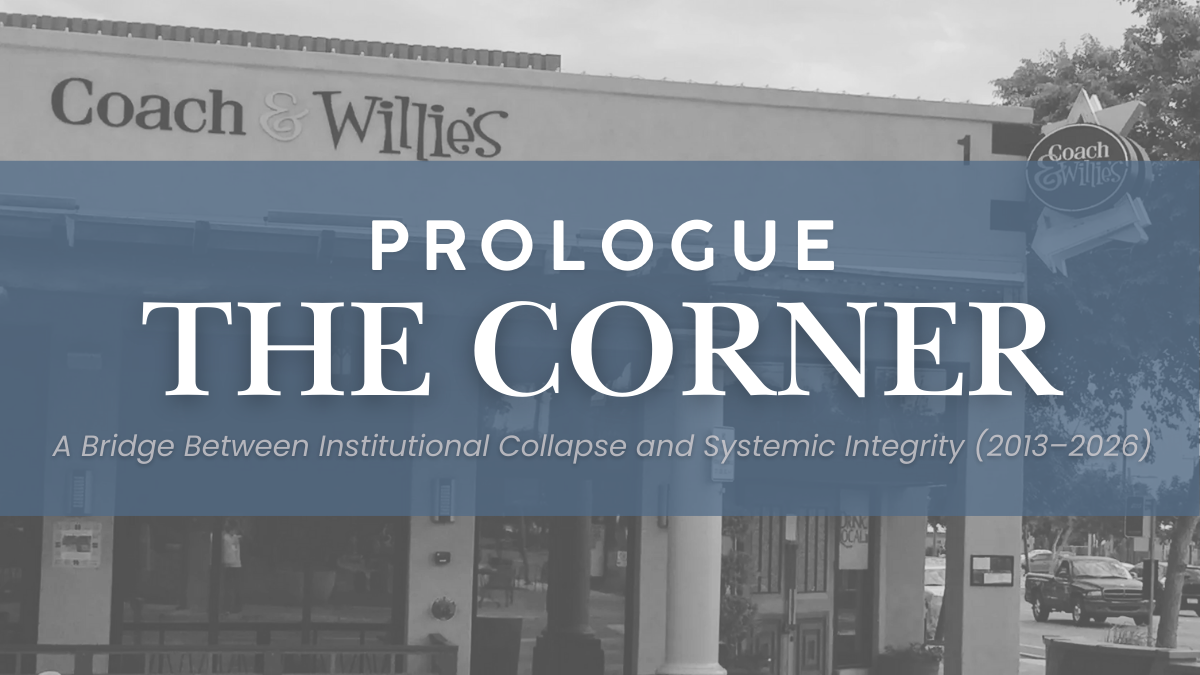
I was home, accepting the fact that I would never see the corner of Arizona Avenue and Boston Street again. There used to be a porn shop on that corner—headless mannequins in lingerie that never fit quite right, cigarette smoke drifting out the front door like a confession no one asked to hear. Minivans with CTR bumper stickers—“Choose the Right”—parked out front. Young men in dark pants and white shirts, the uniform of faith, would emerge carrying little black bags, slip into their vehicles, and drive away.
Around town, everyone knew what that corner was. Nobody said it out loud. During the 2008 Economic Crisis, that shop moved more little black bags than any business in Chandler.
I had turned that corner a thousand times on my way to Inspirador. The 1924 hardware store I had transformed into a wedding venue sat three doors down, at 63 East Boston Street. Every morning I would pass the shop, turn onto Boston, and pull into the alley behind my building. The routine became invisible, the way repeated motion always does—until one morning in April 2013, when I knew I would never make that turn again.
The neighbors whispered “scandal.” The East Valley Tribune wrote “controversy.” Those are the words people use to avoid looking too deeply—labels that reduce years of building to a headline. But scandal and controversy don’t survive economic collapse. Ecosystems do.
While the rest of the country watched their neighbors’ front yards get staked with “Bank Owned” signs in a wave of forced foreclosures, the minivans with their CTR bumper stickers never missed a turn. They parked out front like they were making a grocery run. The young men in their missionary uniforms carried those little black bags with the same dead-eyed focus others gave to a briefcase. Normal. Routine. The shop did not just survive the crisis; it thrived because the moral performance was the only currency that had not been devalued.
Pattern-Seeing: Mechanisms in Plain Sight
A local restaurateur remodeled that same shop while Inspirador was still operating, improving every detail. Within two years, developers wanted the corner, and the restaurant was shut down in a lease dispute they could not win. The business was not a failure; the paperwork was a trap. A different mechanism on the same corner.
The City of Chandler spent those same years condemning dozens of homes and businesses—six acres cleared for private development, most of it within blocks of Inspirador. The city’s vision included a breezeway connecting old downtown to the new City Hall rising directly behind my gates. The ideal route went straight through my front doors. A Jack in the Box one block over fought back and won—national brand, national lawyers. The developers built around them.
Different mechanisms. Same outcome. Property improved, equity created, owner displaced. From the outside, it always looks like another failed business. Almost no one digs deep enough to see the structure that made the loss inevitable.
In 2008, I did not see the pattern yet. But that corner, and every corner like it, was teaching me how power operates when everyone agrees not to name what is happening. The city got its breezeway. The developers got their dirt. The church kids got their little black bags. Everyone got a piece of the corner except the people who actually built it.
In the old world, the ledger does not just track the money; it tracks who is allowed to win. I was not just losing a building; I was seeing a system where the scorekeeper, rule‑maker, and beneficiary were all the same institution. I did not need a better lawyer. I needed a system that could not lie.
From Story to System
McGee was Mormon—a man of stated faith, institutional trust, fiduciary responsibility. His wife, Arizona State Representative Kate Brophy McGee, was a community banker who had built her legislative career around education and small business advocacy.
In February 2008, he wrote to the SBA Office of Inspector General with false fraud accusations against me, claiming I had colluded with his own Business Development Officer to defraud the loan program. He attached a case referral form and a fabricated balance sheet bearing my signature—numbers slightly wrong, as if an amateur had forged it. The document was his invention, one of many he would later fight to keep sealed in court.
The SBA declined to investigate. Buried in their response was one line: “It would appear an adverse change has occurred.” That was the killswitch—the language he needed to cancel funding on a performing loan. Manufactured adverse change where none existed.
Years later, when I filed my lawsuit with forensic evidence of his falsified documents and manufactured crisis, his attorneys moved to seal the case during her campaign. They argued the court had “supervisory power over its own records” when files “might become a vehicle for improper purposes.” The judge agreed. Evidence disappeared from federal record to protect a political campaign. No accountability. No consequences. The minivans were still parking at that corner. The system was working exactly as designed.
Architecture of Extraction
The morning after I lost Inspirador, I did not wake up a CEO. I walked into the backyard and stepped into the pool. The Arizona heat drives you into water the way grief drives you into yourself—May in Phoenix, the temperature already climbing toward 105 degrees by 9 a.m., the kind of heat that makes the air shimmer above the pavement.
I went under. Stayed under. Let the water hold me still. Everything was muted: the pressure in my ears, the muffled sound of the filter motor, chlorine sharp in my sinuses. Sunlight filtered through the surface in shifting patterns. I opened my eyes and watched the light move across the bottom of the pool—bright patches and shadows, constantly rearranging, never settling.
When I surfaced, I could hear the neighborhood again. Someone’s sprinkler system cycling on. A car door closing. A dog barking. And I kept seeing that corner—Arizona and Boston, the minivans, the little black bags, the young men in their uniforms of faith.
The system that let that corner exist—that let contradiction thrive because naming it would disrupt the economic engine—was the same system that let McGee operate with hidden incentives. Accusation substituted for evidence. Extraction masqueraded as protection. He did not need to be malicious. He only needed a system that rewarded the moves he made.
As I floated there, another memory surfaced: the day McGee came to Inspirador after he had already filed his false accusations and manufactured the adverse change. He stood at the gate, shook my hand, his eyes fixed somewhere past my shoulder. I remember how lightheaded I felt when our hands released, as if my body understood something my mind still refused to see in a man wrapped in faith, institutional trust, and fiduciary responsibility.
I held my breath until my lungs burned. Came up gasping. I was still here. And I understood—not just what McGee had done, but the architecture that had protected him while he did it. I had not failed. Inspirador had worked. Together, we had succeeded inside a system designed to allow exactly what happened to us.
I climbed out of the water, dripping onto the hot gravel, feeling the desert air evaporate the water from my skin. The heat in Phoenix is honest; it tells you exactly how much time you have before the singe hits. But the paperwork in McGee’s files? That was a different kind of ghost. I accepted then that if one person can delete another’s existence with a stroke of a pen and a friendly judge, then the pen is a weapon and the paper is a prison. I was done trusting those with pens. I was looking for a truth that lived in the math, somewhere no McGee could reach and adjust to their liking.
From Collapse to Frameworks
Marie McDonnell had submitted her expert declaration during the litigation—thirty years of forensic accounting experience, a Certified Fraud Examiner who had exposed robo-signing on 60 Minutes and trained FBI and DOJ on fraud detection. Her analysis was unequivocal. Documents spread across the conference room table like puzzle pieces—page by page, line by line, calculator beside a glass of water. Marie worked the way forensic accountants work: methodically comparing what one party certified against what another party recorded. A chain of agreements—separate, but linked by clauses, signatures, and dates.
The loan amount certified to the SBA: 1.15 million dollars. The loan amount on the recorded Promissory Note: 1.4 million dollars. A 250,000‑dollar discrepancy—the exact amount of the City of Chandler grant that was restricted for working capital, not available for manipulation. Two sets of numbers. One the borrower sees. One the SBA sees. Both certified as accurate by parties who colluded to hide the discrepancy.
The 504 program’s three‑party structure—bank, CDC, and borrower—was designed to protect the SBA and taxpayer dollars through independent verification at every step. The certifications were meant to function like interconnected legal agreements, each party validating the others. McGee found the gaps. He bent the chain of agreements without needing to break it—certifying amounts one party saw while others never questioned what they had not verified.
Her expert declaration concluded: “For all of the reasons explained above, the entire transaction has been tainted by fraud rendering the promissory notes and their modifications and extensions unenforceable.” She went further: “Compass Bank has no right to foreclose the Property because it has dirty hands and should not be allowed to profit from its bad faith and fraudulent activities.”
The fraud was McGee’s—documented in his falsified certifications and manufactured adverse change. His ability to bend the chain of agreement was not a glitch; it was a feature. McGee did not break the system; he used it exactly as it was intended to be used. He operated in the “gray”—that comfortable, dark space between what is certified and what is recorded. In the corporate world, they call this “fiduciary discretion.” When that discretion is used to manufacture a crisis, it is simply extraction masquerading as oversight.
Marie McDonnell’s forensic audit proved the fraud, but the system’s armor was already too thick. The documents were sealed, the campaign was won, and the extraction was complete. But here is the thing about an “adverse change”: once you see the architecture of the shadows, you realize the only way forward is to build in the light.
The traditional financial systems are built on shadows and handshakes, on the fragile hope of human integrity and trust. I have moved toward the math—where the ledger is immutable, the process is transparent, and the truth does not require a judge’s permission to exist. The future is trustless.
I could not build in the same water. But the instinct that made me a builder in the first place—the one that saw possibility in a 1924 hardware store, designed operating systems before I had language for it, recognized patterns others missed—that was still intact. One question kept surfacing: Where can I build where the architecture protects the builder?
It would require different infrastructure entirely. Where verification does not require someone in authority agreeing your proof is sufficient. Where evidence does not require interpretation. Where the chain of title cannot be broken because it is encoded by design. I did not have the language for it yet. But I knew I was looking for it. I had just learned to navigate the unknown.
What comes after collapse is not survival. It is architecture audit—the middle space where resilience is less important than learning how the structure actually works. I spent the next seven years learning to see the question I should have asked before I built the first time: Where can I build where the system cannot rewrite the rules? That question became six frameworks. This is how I found them.
About the Author
Dilia Wood is a historic preservationist, adaptive reuse developer, and writer who explores the intersection of institutional integrity and individual agency. She transformed the historic O.S. Stapley Hardware Store into a multimillion‑dollar event venue—a project that became a landmark for downtown Chandler, Arizona.
Today, she translates that structural education into frameworks for founders, developers, and educators navigating institutions not designed for their protection.
Connect on LinkedIn · Substack
Follow the Complete Series
Get notified when new chapters are released. Download the complete framework with all teaching materials when the series is complete.
No spam. Unsubscribe anytime.